



The Calculation
 How is the mass of the Earth determined? Newton, Galileo, Henry Cavendish, and Eratosthenes contributed to this amazing calculation.
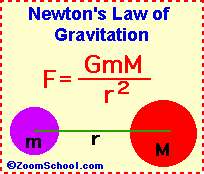
This calculation is done using Newton’s Law of Gravity, which formulates the attractive force (gravitational force) that two masses exert on each other:
F=GmM/r2
- In Newton’s equation, F is the gravitational force, G is a constant of proportionality, M and m are the two masses exerting the forces, and r is the distance between the two objects.
- G was calculated by Henry Cavendish in 1798, and was determined to be 6.67 x 10⁻¹¹ m3/(kg sec2).
- Also needed is Newton’s second law of motion, F=ma, where F is the force applied to an object, m is the mass of the object, and a is its acceleration due to the force.
- Galileo determined that the acceleration due to the force of gravity of Earth was a constant equal to 9.8 m/sec2 near the surface of the Earth.
- Lastly, you need to know the radius of the Earth; this was first calculated by the Greek Eratosthenes thousands of years ago (by comparing shadows in wells during the summer solstice about 230 B.C.).
Calculating the mass of the Earth
- F = GmM/r2 = ma, where F is the gravitational force, G is the gravitational constant, M is the mass of the Earth, r is the radius of the Earth, and m is the mass of another object (near the surface of the Earth).
- GM/r2= a (The m’s canceled out.) Now solve for M, the mass of the Earth.
- M = ar2/G, where a = 9.8m/sec2, r = 6.4 x 10⁶m, and G = 6.67 x 10⁻¹¹m3/(kg sec2).
- M = 9.8 x (6.4 x 106)2/(6.67 x 10-11) = 6.0 x 1024 kg
The People Behind the Calculation
- CAVENDISH, HENRY
 Henry Cavendish (1731-1810) was an English chemist and physicist. Cavendish discovered that hydrogen gas was a substance different from ordinary air (whose components he analyzed), described the composition of water (hydrogen and oxygen) and other important works. Cavendish was the first person to determine Newton’s gravitational constant gravitational constant and accurately measured of the Earth’s mass and density.
 - ERATOSTHENES
- Eratosthenes (276-194 BC) was a Greek scholar who was the first person to determine the circumference of the Earth. He compared the midsummer’s noon shadow in deep wells in Syene (now Aswan on the Nile in Egypt) and Alexandria. He properly assumed that the Sun’s rays are virtually parallel (since the Sun is so far away ). Knowing the distance between the two locations, he calculated the circumference of the Earth to be 250,000 stadia. Exactly how long a stasia is is unknown, so his accuracy is uncertain. He also accurately measured the tilt of the Earth’s axis and the distance to the sun and moon, and devised a method for determining the prime numbers up to a given number (the Sieve of Eratosthenes). Eratosthenes made numerous contributions to the sciences and arts in many fields, including geography, mathematics, astronomy, chronography (calendars), music, and literature. Eratosthenes was a brilliant all-around scholar; although not the top expert on any topic, he was well-versed in all subjects, and therefore nicknamed “Beta” (which is the second letter of the Greek alphabet).
- GALILEI, GALILEO
 Galileo Galilei (1564-1642) was an Italian mathematician, astronomer, and physicist. He was the first person to use a telescope to observe the skies (in 1609). Galileo discovered four moons of Jupiter, observed the phases of Venus, studied sunspots, and discovered many other important phenomena. After publishing the many discoveries he made using his telescope, including the motion of the Earth around the Sun (the Copernican System), Galileo was accused of heresy by the Inquisition (in 1633).
- NEWTON, ISAAC
 Isaac Newton (1642-1727) was an English mathematician and physicist who invented calculus (simultaneously, but independently of Leibniz), formulated the laws of gravitation and mechanics, investigated the nature of light (he discovered that sunlight is made of light of different colors).